No Religion Older than Truth
A historical and linguistic examination of Theosophy's claim to primordial wisdom — with the Christian responses, confession by confession, and particular attention to the age of the books of Thoth.
"There is no religion higher than truth."
— Motto of the Theosophical Society, adopted 1875. The present paper takes the motto at its word.Abstract
Theosophy stands or falls on a single historical claim: that behind all religions lies one primordial Wisdom-Religion, preserved intact by hidden adepts and re-stated by H. P. Blavatsky from documents of immense antiquity. This paper examines that claim on its own terms — documentary, linguistic, and historical — and finds that every text alleged to carry the ancient doctrine dates, on examination, to within recent centuries or to Blavatsky's own desk. The Greek Hermetica, the movement's claimed Egyptian taproot, were dated by Isaac Casaubon in 1614 to the early centuries AD, a verdict philology has only refined. The Book of Dzyan has never been produced. The Mahatma letters failed forensic examination in 1885. The "secret doctrine's" sources were traced, page by page, to a Victorian library in 1895. The traditions Theosophy claimed as its children — Buddhist, Hindu, Christian — each formally repudiated the paternity. We survey the Christian responses across the confessions, giving particular weight to the Protestant documentary tradition whose philological method did the earliest demolition work, and close with the case of Valentin Tomberg, the Theosophically-trained esotericist whose return to the Church suggests what the movement's real, and legitimate, hunger was for.
Part I · The proposition
The claim on the table
Every religion makes claims that escape the historian — about God, the soul, the end of things. Theosophy is unusual in that its central claim does not. Founded in New York in 1875 by Helena Petrovna Blavatsky, Henry Steel Olcott, and William Quan Judge, the Theosophical Society taught that all historical religions are decayed publications of one primordial Wisdom-Religion: a body of doctrine older than Egypt, preserved without corruption by a brotherhood of living adepts, and re-stated — not invented — by Blavatsky in Isis Unveiled (1877) and The Secret Doctrine (1888), the latter presented as commentary on stanzas from a "Book of Dzyan" of pre-human antiquity.[1–3]
This is not a claim about the invisible world. It is a claim about books, dates, and transmission — the kind of claim that libraries, philology, and forensic examination can test. Blavatsky understood this and welcomed it; her works bristle with citations, manuscripts, and named authorities precisely because the system's warrant is historical: we are older, therefore prior, therefore true. The gospels are late copies; the Mysteries are the original. Jesus is one initiate in a chain running back through Buddha and Pythagoras to Hermes Trismegistus — thrice-greatest Hermes, the Hellenized Thoth of Egypt — and behind him to the archaic East.
The present examination therefore needs no theology to get started. It asks only the question the motto invites: is it true? Specifically — are the documents as old as claimed; do the alleged ancient sources exist; and when the traditions named as heirs were consulted, did they recognize the parent? We will take these in order, and only then turn to what the Christian confessions made of the matter, since their case is strongest when it rests on the same documentary ground.
One point of method, stated plainly at the outset: nothing below argues that mystical experience is fraudulent, that the questions Theosophy asked were foolish, or that Christianity wins by default if Blavatsky loses. The argument is narrower and, for that reason, harder to escape: the historical lineage on which the system stakes its authority does not exist, and the evidence for this is not Christian polemic but the published record — much of it produced by investigators with no confessional stake at all.
Rabbit holes · the primary texts
- Blavatsky, The Key to Theosophy (1889) — her own catechism; the fastest honest route into what the system actually taught.
- Blavatsky, The Secret Doctrine, vol. I (1888) — the master text; read the Proem and the first stanzas of Dzyan.
- Blavatsky, Isis Unveiled (1877) — the earlier, Hermetic-flavoured work; keep it open beside Coleman's source analysis (§III).
- Sinnett, Esoteric Buddhism (1883) — the first systematization of the Mahatma letters' teaching.
Part II · The linguistic case
How old are the books of Thoth?
Begin with the deepest root, because the whole tree hangs from it. The perennialist lineage — Renaissance, Theosophical, and New Age alike — runs back to Hermes Trismegistus: the Greek Hermes fused with Thoth, Egypt's god of writing and wisdom, alleged author of a corpus of primordial revelation. And here a distinction must be made with some care, because the plausibility of the entire "Egyptian wisdom" genealogy lives in the blur between two very different things.
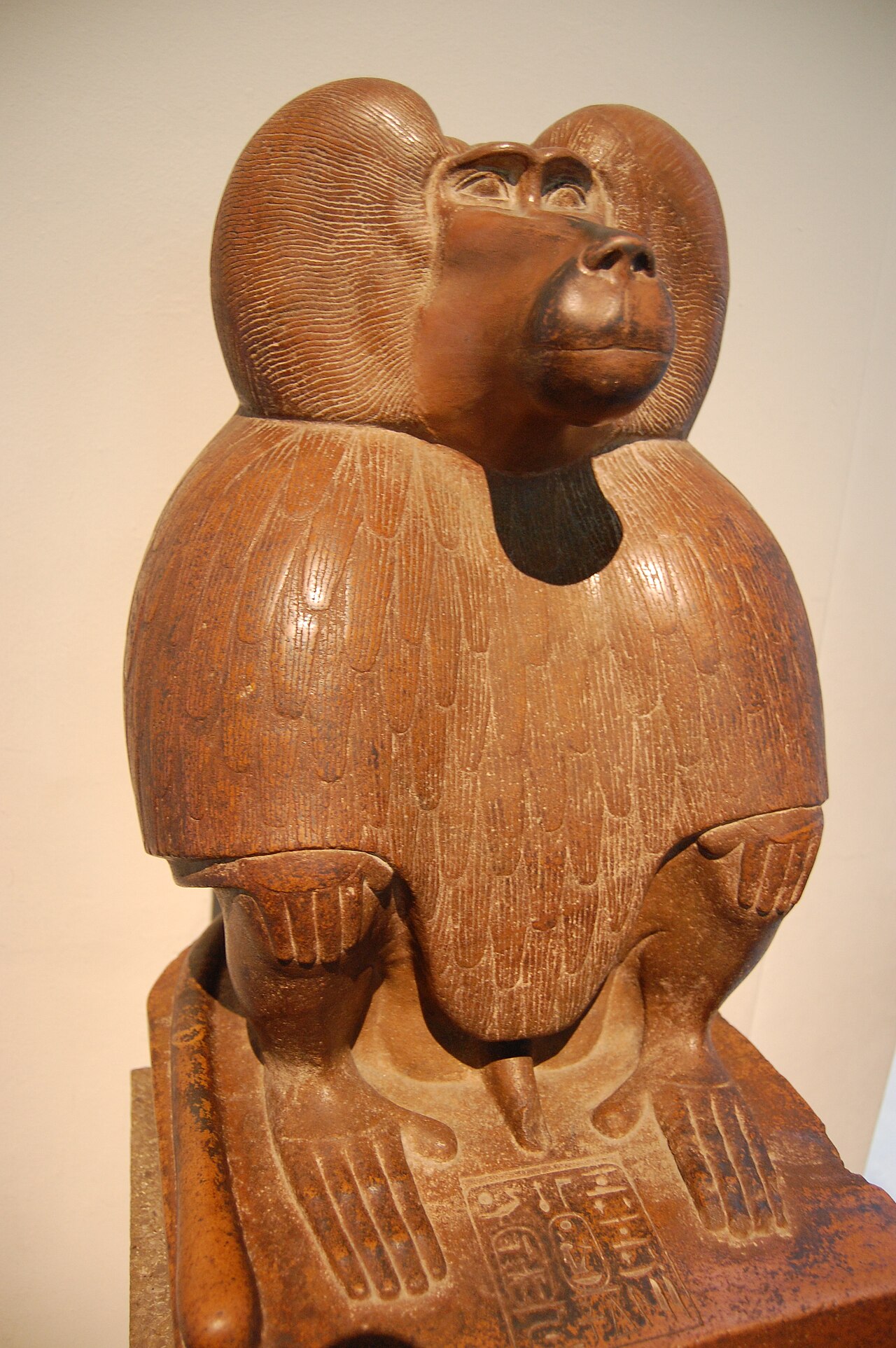
Thoth is genuinely ancient. The god is attested from the Old Kingdom; his cult at Hermopolis, his ibis and baboon forms, his role as scribe of the gods and reckoner of hearts at judgment — all of this is real Egyptian religion, millennia old. There was even a real Egyptian literature of Thoth: Clement of Alexandria mentions forty-two "books of Hermes" carried in temple procession, and modern scholarship has recovered a Ptolemaic-era Demotic dialogue now called the Book of Thoth, a genuine product of the Egyptian scribal house of life.
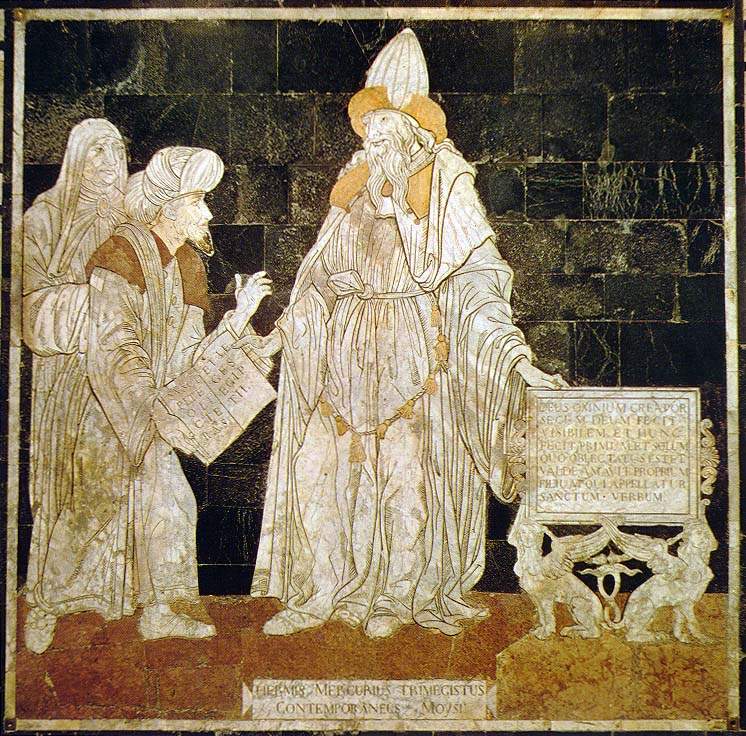
The Hermetica are not. The texts the tradition actually transmits — the seventeen Greek treatises of the Corpus Hermeticum, the Latin Asclepius, the fragments in Stobaeus — are compositions of Roman Egypt, written in Greek between roughly the first and third centuries AD: Middle-Platonic philosophy with an Egyptian accent, produced perhaps a millennium and a half after the age of Moses to which the tradition assigned them.[12,13,16] This is not a hostile fringe view; it has been the settled conclusion of philology for four hundred years, and it was reached first not by a sceptic but by a devout Reformed scholar doing textual criticism.
Casaubon, 1614: the first carbon-dating
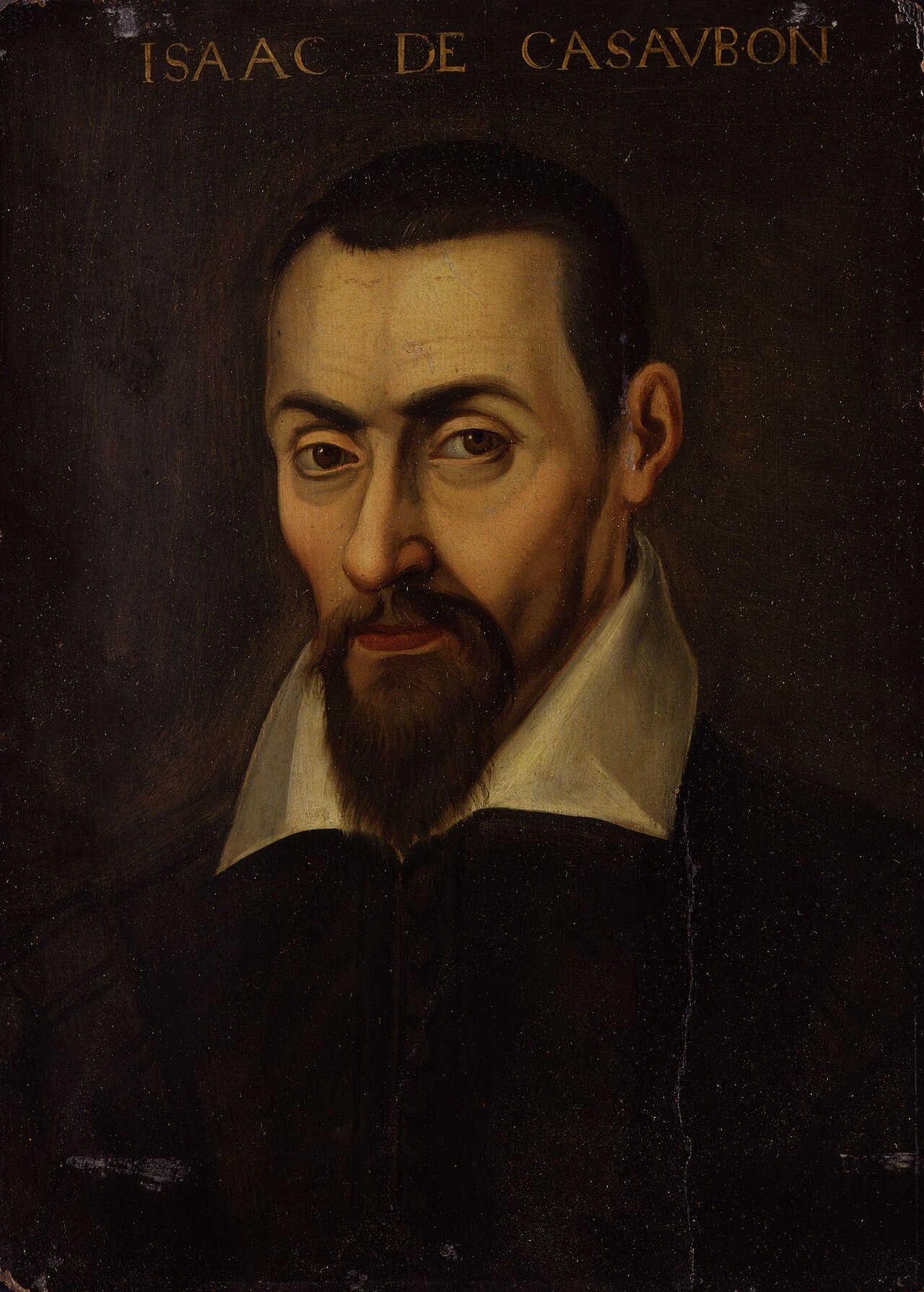
Isaac Casaubon — Geneva-trained Huguenot, by then the foremost Greek philologist in Europe, working in England under James I — published his De rebus sacris et ecclesiasticis exercitationes XVI in 1614, a critical assault on Cardinal Baronius's church history. Buried in the first exercitation is a sustained demonstration that the Hermetic writings cannot be what fifteen centuries had believed.[4] His arguments were purely internal, and they remain a model of the method:
The Greek is late. The treatises are written not in anything resembling translation-Greek from an Egyptian original, but in the philosophical koine of the imperial era, using technical vocabulary that did not exist before the later Platonic schools. A text cannot deploy the coinage of Athens centuries before Athens minted it.
The content is derivative. Doctrines paraded as primordial are recognizably lifted from Plato and the Septuagint; the "Egyptian" prophet echoes Genesis in its Greek wording and breathes the atmosphere of early Christian and Jewish Alexandria. The alleged source reads like a digest of its supposed descendants.
The silence is total. No classical author — not Plato, not Herodotus writing at length on Egypt — cites these texts. They surface exactly when their language and doctrine suggest: in late antiquity, quoted first by Christian writers of the second and third centuries.
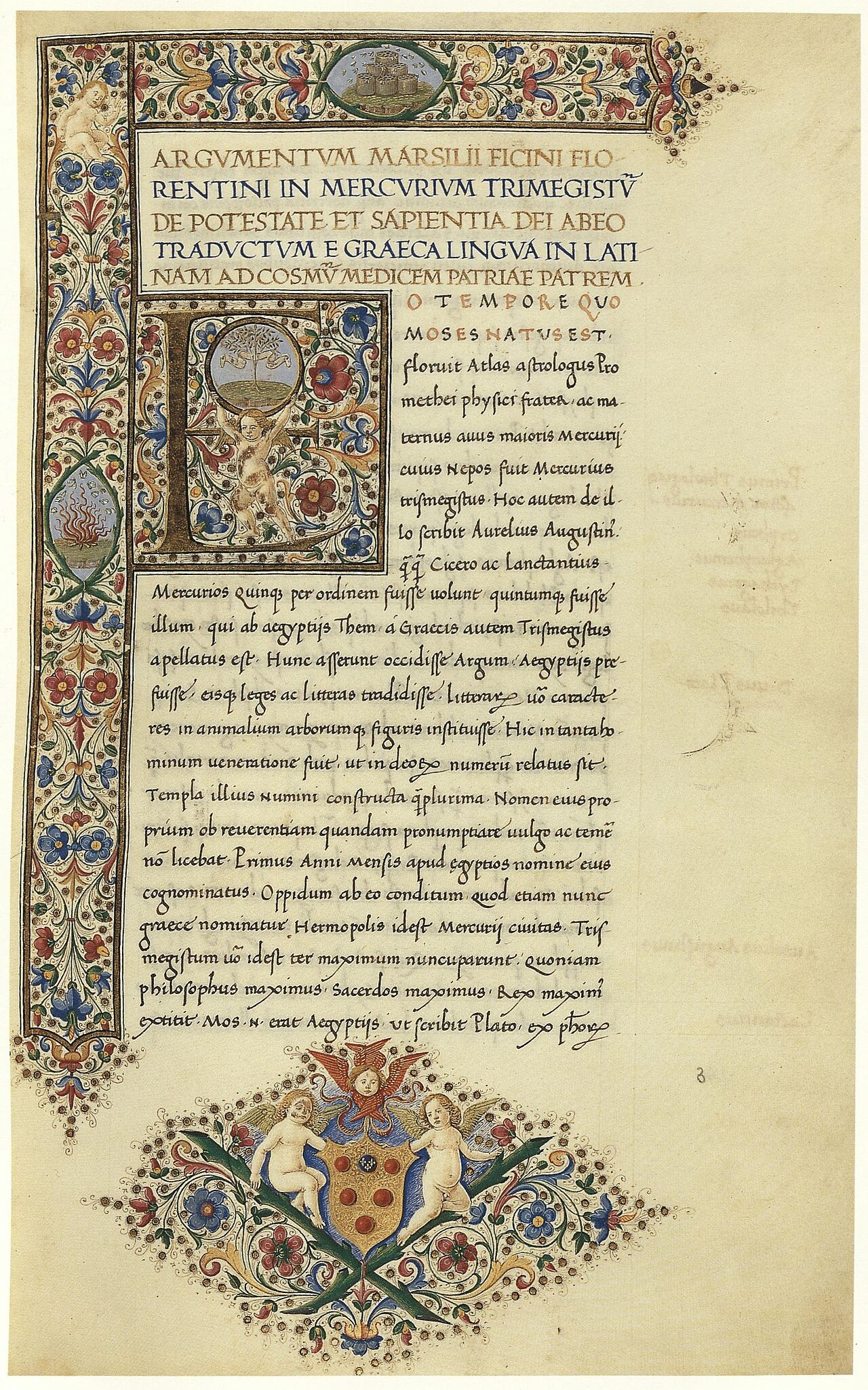
Note what happened next, because it is the pattern for everything in Part III. The learned world checked Casaubon's evidence and conceded. The prisca theologia — the "ancient theology" on which Ficino, Pico, and a century and a half of Renaissance Hermetism had rested — collapsed among scholars within a generation.[14] Modern research has refined, not reversed, the verdict: Festugière's great study treated the corpus as essentially Greek popular philosophy; Fowden and the Nag Hammadi finds have restored a real Egyptian milieu — Coptic Hermetica, priestly motifs, that Demotic Book of Thoth — but the dating stands where Casaubon put it.[13,16] The texts are genuinely interesting products of Greco-Egyptian late antiquity. They are not the library of primordial man.
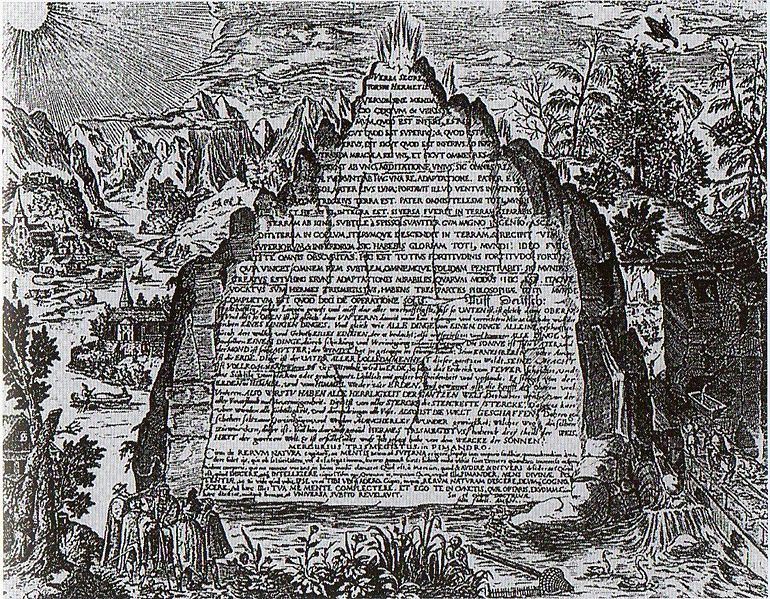
And the famous Emerald Tablet — "as above, so below," the compressed creed of the whole occult tradition? Its earliest attestation is an Arabic text of roughly the eighth or ninth century AD, embedded in the pseudo-Apollonius Sirr al-khalīqa; it reached Europe by medieval Latin translation. It is a venerable text of medieval alchemy. It is not, by more than three thousand years, what Blavatsky's tradition needs it to be.
Rabbit holes · the Hermetica
- Casaubon, De rebus sacris… exercitationes XVI (1614) — the primary source itself; the Hermetic discussion is in Exercitatio I.
- Mead, Thrice-Greatest Hermes (1906) — full English Hermetica by a Theosophist scholar; read the texts and judge their flavour yourself.
- Corpus Hermeticum — scholarly overview and the Emerald Tablet's actual transmission history.
- The Demotic Book of Thoth — the genuine Egyptian Thoth-literature, and how unlike the Greek corpus it is.
- Brian Copenhaver, Hermetica (Cambridge, 1992) — the standard modern translation; its introduction is the best single account of the dating question.
Part III · The documentary case
The missing library
If the Egyptian root fails, Theosophy's fallback is the Eastern one: the Book of Dzyan, the Senzar language, the Tibetan Brotherhood, the Mahatma letters. Here the problem is starker than a wrong date. A wrong date at least requires a document. In this section, wherever a document was produced it failed examination, and wherever examination was invited the document was never produced.
The Book of Dzyan and the language of Senzar
The Secret Doctrine presents itself as commentary on stanzas from "the Book of Dzyan," written in "Senzar," a secret sacerdotal tongue. In the century and a half since 1888 — a period in which Tibetology went from infancy to a mature discipline, in which the Tibetan canons were catalogued, in which Sanskrit and Central Asian philology recovered whole lost literatures from the Silk Road sands — no manuscript, no fragment, no quotation, no catalogue entry, and no native mention of any such book or any such language has ever surfaced.[8] Friedrich Max Müller, the era's most eminent orientalist, examined the alleged Eastern learning and pronounced it what a Sanskritist would: the blunders of an enthusiastic amateur, with "esoteric Buddhism" itself a contradiction — the Buddha's teaching being, of all ancient doctrines, the most insistently public.[8] The earliest attestation of the world's oldest book remains the London printing of 1888.
The Mahatma letters: the case that was examined
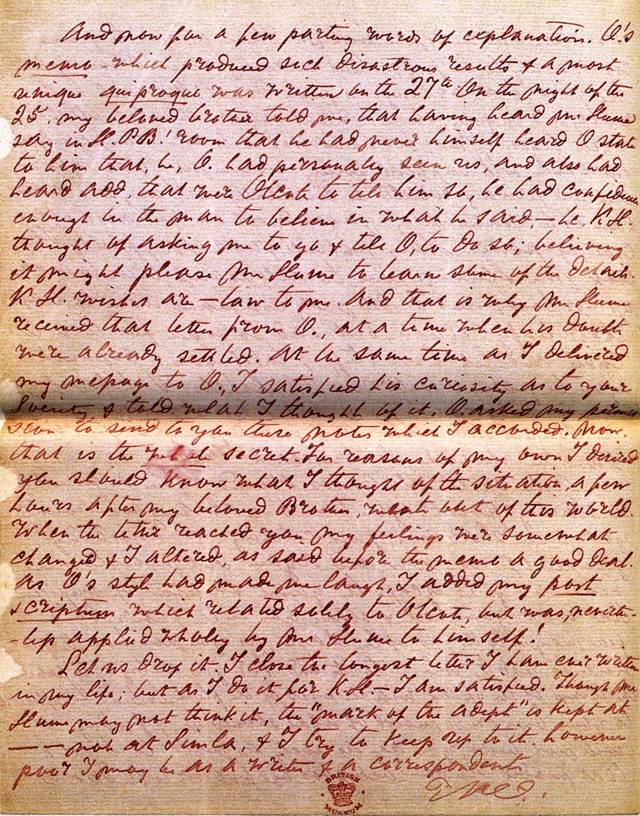
The Masters, unlike the Book, left physical evidence: some 1,400 pages of letters, materializing in railway carriages and dropping from ceilings, now held in the British Library. In 1884 the Society for Psychical Research — a body founded by Cambridge scholars precisely to investigate such claims sympathetically — sent Richard Hodgson to India after Emma and Alexis Coulomb, Blavatsky's own housekeepers at Adyar, published letters describing how the phenomena were staged, including the shrine cabinet with its sliding back panel through which "precipitated" letters arrived.[5] Hodgson spent months on site: interviews, measurements, handwriting comparison. The SPR committee's 1885 report concluded that the phenomena were fraudulent and the Mahatma scripts were, in the material examined, in Blavatsky's disguised hand, closing with the era's most quoted verdict — that she deserved remembrance as "one of the most accomplished, ingenious, and interesting impostors in history."[5]
Fairness requires the sequel: in 1986 the SPR's journal published Vernon Harrison's "J'Accuse," a professional document-examiner's critique arguing Hodgson's handwriting analysis was biased and below forensic standard (the SPR itself, holding no corporate opinions, endorsed neither report).[6] Read both; that is what the links are for. But observe the shape of even the friendliest outcome: a century of controversy over whose hand wrote the letters — with the Coulomb testimony, the trapdoor shrine, and one further incident standing regardless. In 1883 it was noticed that a Mahatma letter published by Sinnett reproduced, nearly verbatim, passages from a speech the American spiritualist Henry Kiddle had delivered at Lake Pleasant in 1880. The Master's explanation, when pressed, was an error in psychic "precipitation." The reader may weigh that explanation against the ordinary one. Trans-Himalayan adepts guarding the primordial wisdom do not, on the face of it, need to crib from a Poughkeepsie camp lecture two years old.
Coleman, 1895: the secret doctrine's actual bibliography
The decisive work, though, was done not on the letters but on the books, by William Emmette Coleman, an American orientalist bibliographer who set out to source Blavatsky's erudition line by line. His published analysis identified in Isis Unveiled some two thousand passages taken without credit from roughly one hundred contemporary works — Wilson's translation of the Vishnu Purāṇa, Ennemoser's History of Magic, Dunlap, Jacolliot, Donnelly's Atlantis for the Atlantean material — demonstrating that the apparent command of a thousand ancient sources was mediated, at second hand, through a compact shelf of Victorian books, errors included.[7] Copied errors are philology's fingerprints: an ancient adept might know Wilson's Vishnu Purāṇa; he would not reproduce Wilson's mistranslations.
And the doctrine carries the same fingerprints as the footnotes. The "archaic" system is built of conspicuously nineteenth-century materials: progressive evolution through rounds and races (Darwin's decade, cosmologized); Devachan, a refit of the spiritualists' Summerland; Atlantis via Donnelly (1882). Its one systematic divergence from the traditions it claims — replacing liberation-from-the-wheel with evolution-up-the-ladder — is precisely its debt to the Victorian idea of progress. The doctrine is datable by its content as surely as the Hermetica were by their Greek.
Claimed sources of immense antiquity: never produced. Physical evidence produced: judged fraudulent by the era's most sympathetic investigative body, with the rehabilitation attempt itself contested. Erudition: traced to contemporary books. Doctrine: datable to its own decade by internal evidence. On the historical claim as stated — we are older, therefore true — there is, at present, no surviving evidence in the affirmative.
| Text / doctrine | Claimed age | Earliest actual attestation | Gap |
|---|---|---|---|
| Corpus Hermeticum | Primordial; "contemporary of Moses" (Renaissance); archaic Egypt (Theosophy) | Greek, c. 100–300 AD (Casaubon 1614; philological consensus since) | ~1,500–3,000 yrs |
| Emerald Tablet | Primordial Hermes | Arabic, c. 8th–9th c. AD | ~3,000+ yrs |
| Book of Dzyan / Senzar | "Oldest book in the world," pre-human antiquity | London, 1888 (The Secret Doctrine itself) | total |
| Mahatma teachings | Archaic trans-Himalayan wisdom | 1880s letters; content traceable to 1870s–80s print sources | total |
| "Hermetic axioms" (Kybalion) | Ancient Egypt | Chicago, 1908 (W. W. Atkinson) | total |
| For comparison: Pauline letters | 1st c. AD (claimed) | 1st c. AD (undisputed, incl. by critical scholarship) | 0 |
Rabbit holes · the investigations
- SPR Proceedings, vol. III (1885) — contains the full Hodgson Report. Long, specific, and stranger than any summary.
- Harrison, "J'Accuse" (1986) — the forensic counter-case, republished by the Theosophical University Press. Read it against Hodgson and form your own view.
- Solovyov, A Modern Priestess of Isis (1895) — hostile memoir by a former intimate; Coleman's source-analysis appears as an appendix.
- Hodgson Report — neutral overview · Stanzas of Dzyan — the search for the book · The Mahatma letters and their custody.
- Max Müller, Theosophy, or Psychological Religion (1893) — the Gifford Lectures in which the great Sanskritist staked out his ground; his periodical piece "Esoteric Buddhism" (The Nineteenth Century, May 1893) pressed the philological charge directly.
Part IV · The heirs decline the inheritance
The verdict of the borrowed traditions
A theory claiming to be the esoteric core of all religions has one further court to face: the religions. If Theosophy were what it said, one would expect the learned representatives of Buddhism and Hinduism — flattered, after all, with the deepest pedigree — to recognize their own teaching in it. What happened was the opposite, in each case on the record, and in each case on a point of doctrine, not of personality.
Buddhism. The Buddha's most distinctive doctrine — the one by which Buddhism defines itself against Hinduism — is anattā: no permanent self, no ātman migrating from life to life. Theosophy's third fundamental proposition asserts precisely the permanent pilgrim-soul, identical with a Universal Over-Soul. The system marketed as "Esoteric Buddhism" thus contradicts Buddhism at its single most self-defining point, and can escape only by claiming that all Buddhist authorities misunderstand their own canon. Anagarika Dharmapala — whose early career the Theosophists genuinely aided, a debt honestly acknowledged on all sides — broke with the Society on exactly these grounds: what it taught was not the Dhamma.
Hinduism. Dayananda Saraswati's Ārya Samāj formally allied with the Theosophical Society in 1878 and formally repudiated it by 1882, the founder denouncing Blavatsky's claims after direct acquaintance. And Vivekananda — routinely shelved beside Theosophy in Western bookshops — wrote of the movement with contempt in "Stray Remarks on Theosophy":
"The Hindus have enough of religious teaching and teachers amidst themselves even in this Kali Yuga, and they do not stand in need of dead ghosts of Russians and Americans." — Swami Vivekananda (full text)
The pattern generalizes. Theosophy's doctrine of exceptionless, unassisted karma erases the grace, merit-transfer, and devotional rescue that pervade actual Buddhist and Hindu practice; its evolutionary ladder inverts traditions whose goal is liberation from the wheel, not promotion up it. At every point of contact, the "esoteric core" turns out to require the tradition's own authorities to be wrong about their own religion. A key that fits no lock it was cut for is not the master key. It is a new key.
Rabbit holes · the traditions speak
- Vivekananda, "Stray Remarks on Theosophy" — short, sharp, and from the man himself.
- Dharmapala's alliance and break with the Society · Dayananda and the 1878–82 alliance.
- Anattā — the doctrine on which "Esoteric Buddhism" founders; compare it directly with the Third Fundamental Proposition in the Proem.
Part V · A case study in manufactured parallels
The Egyptian Christ that wasn't
One branch of the lineage deserves its own examination, because it remains the most viral: the claim, descending from the Victorian poet-Egyptologist Gerald Massey through Alvin Boyd Kuhn to Tom Harpur's The Pagan Christ (2004) and the film Zeitgeist (2007), that the gospel narrative is recycled Egyptian myth — Horus born of a virgin on December 25th, attended by three kings, trailing twelve disciples, crucified and raised. If true, this would be the one place the "one myth" thesis touched verifiable ground. It is therefore worth reporting what the verifiable ground contains.
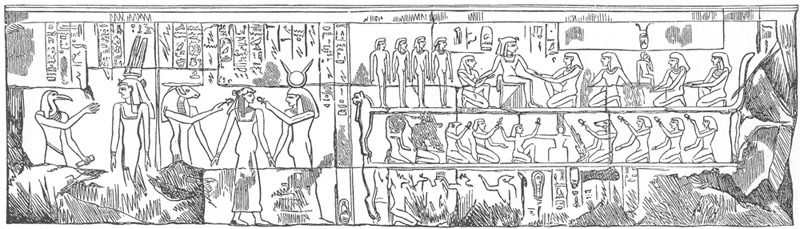
The centrepiece of the claim is a real monument: the birth-cycle reliefs at Luxor Temple. Massey knew them through Samuel Sharpe's mid-Victorian line drawing, reproduced below. What the panels actually depict, as the excavation reports and every Egyptological treatment since describe, is the divine conception and birth of Pharaoh Amenhotep III — Thoth announcing to Queen Mutemwia, the god Amun approaching her, Khnum shaping the royal child on his potter's wheel, the birth attended by divine midwives. There is no virgin (the theology turns on the god fathering the child), no star, no stable, no magi, no December date, and, it bears noting, no Horus: the scene concerns a king's divine legitimacy, a standard genre of New Kingdom royal propaganda. The "nativity parallel" exists in Sharpe's caption tradition and Massey's inference, not in the wall.
The wider inventory fares no better. When the claims of Massey, Kuhn, and Harpur were put to working Egyptologists — W. Ward Gasque circulated the specific assertions, including Kuhn's alleged Egyptian name "Iusa" for Jesus, to twenty specialists — the responses were unanimous: the parallels do not exist in the Egyptian record, and "Iusa" is not an attested word.[9] On the broader "dying-and-rising god" category into which such claims retreat, the standard scholarly demolition is Jonathan Z. Smith's: examined case by case, the category dissolves — Osiris, the closest candidate, dies and remains lord of the dead; he is precisely not raised to renewed earthly life.[15] Even Bart Ehrman — an agnostic critic of Christianity, and therefore useful here precisely because he has no confessional stake — treats the Horus-Jesus material as a textbook case of parallels fabricated by amateurs and repeated without checking.[21]
The method deserves naming, because it is the engine of the whole "one myth" literature: state the Egyptian material in borrowed Christian vocabulary ("baptism" for a purification scene, "resurrection" for continued existence in the netherworld), then present the echo of your own translation as an ancient correspondence. It is the linguistic counterpart of the forged pedigree — and it is the same fingerprint found in Parts II and III: the alleged source, examined, turns out to be a modern composition.
Rabbit holes · checking the parallels
- Gasque, "The Leading Religion Writer in Canada… Does He Know What He's Talking About?" (HNN, 2004) — the poll of Egyptologists on the Massey–Kuhn–Harpur claims.
- Jonathan Z. Smith, Drudgery Divine (1990) and his "Dying and Rising Gods" entry in the Encyclopedia of Religion — the category examined and dissolved.
- Bart Ehrman, Did Jesus Exist? (2012) — a non-Christian scholar on the mythicist parallel industry.
- Gerald Massey · Luxor Temple — trace the drawing to the wall.
Part VI · The confessional responses
The Christian responses, by confession
Christian rejection of Theosophy is unsurprising; what instructs is that each confession rejected it along the line of its own genius, and that the three rejections interlock — metaphysical, mystical, and documentary — like three walls of one building.
Rome: the metaphysical wall
Catholic theology met Theosophy at the level of first principles. In the classical reading of Exodus 3:14 — "I AM THAT I AM" — God is not a being among beings but Being itself, ipsum esse subsistens; creatures participate in being without being identical to it. On this analogy of being, Theosophy's Over-Soul, with which all souls are one in essence, is not a deeper insight but a category collapse — and its ladder of self-achieved divinity runs squarely against grace. The Holy Office made the judgment official in July 1919, replying to the question whether theosophical doctrines are compatible with Catholic teaching with a single word: Negative.[11]
Honesty requires the concession already flagged at Exhibit E: Rome itself spent the Renaissance believing the false Hermetic dating — Hermes is in the floor at Siena, and Ficino translated the corpus on a cardinal's patronage. But note what the concession actually shows: the Church corrected itself by philology, absorbed the correction, and drew the line it has held since — esoteric speculation tolerable as commentary, never as rival revelation. Institutions that can be wrong and then persuaded by evidence are, on the point at issue here, the opposite of the closed loop described in Part IV.
Orthodoxy: the mystical wall
The Christian East never needed Theosophy's product, because it carried a licit version in stock. Theosis — "God became man that man might become god," in Athanasius's formula — offers real participation in the divine life, while the essence/energies distinction of Gregory Palamas guards the line Theosophy erases: the creature shares God's energies, never His essence; becomes god by grace, not God by nature. This is why the Orthodox critique of Theosophy is the least anxious of the three: it reads the movement not as a temptation but as an ersatz — the Western spiritual hunger for divinization, returning in counterfeit form to a market the West had stopped supplying. The remedy, on this view, is not less mysticism but the real article, under discipline.
The Protestant case: the documentary wall — and the sharpest
The Protestant rejection is the one this paper has, in effect, been executing all along, for the Reformation's decisive move was to stake religion on documents — their text, their date, their transmission — and to build the philology to try them. It was Lorenzo Valla's textual criticism (a Catholic's, gladly adopted by Protestants) that exposed the Donation of Constantine in 1440; it was the same method in Casaubon's Reformed hands that dated the Hermetica in 1614; and it is the same method that finds the Book of Dzyan missing and Isis Unveiled's sources on a Victorian shelf. Sola scriptura is, among other things, an evidential discipline: revelation is bounded by a public, datable canon, and claims of ongoing secret revelation — Rome's unwritten traditions or Tibet's unproduced stanzas alike — face the same demand. Produce the documents.
What gives the Protestant case its edge is that it accepts the same test for its own claims — and the asymmetry of results is the argument. Paul stakes everything on a public, falsifiable-in-principle event: "if Christ has not been raised, your faith is futile," followed by a list of named, then-living witnesses. The creed he quotes in 1 Corinthians 15 is dated by critical scholarship — including scholars with no faith commitment — to within a few years of the crucifixion; the letters transmitting it are undisputedly first-century; papyrus fragments of the gospels survive from within living memory of their composition. Set that column of Table 1 against the others. Christianity's founding documents are, precisely, producible: early, public, abundantly copied, and open to hostile examination for three centuries of critical scholarship that has narrowed, not widened, the gap between event and text. Theosophy's are late, secret, unproduced, or exposed. A Reformed critic of Warfield's stamp would add the theological diagnosis — ongoing miracle-working revelation after the apostolic age is precisely where counterfeits breed[17] — but the diagnosis is not needed for the verdict. The documents render it alone.
One Protestant irony, recorded for completeness: the confessional mainstream that expelled esotericism most thoroughly also incubated, in its Pietist underground, the one genuinely Christian esoteric system — Jacob Böhme's — proving that the hunger Part VII describes ran on both sides of the Reformation divide. The mainstream answer was consistent, however: what Scripture does not warrant, no inner light can.
Rabbit holes · the confessions
- AAS 11 (1919) — find the Holy Office responsum on "doctrinae theosophicae."
- Augustine, City of God VIII — the patristic cross-examination of Hermes, fifteen centuries before Casaubon.
- Warfield, Counterfeit Miracles (1918) — the classic Reformed treatment of post-apostolic wonder-claims, Theosophy's decade included.
- Valla and the Donation of Constantine — the founding precedent of pedigree-testing philology.
- Theosis and the essence–energies distinction — the licit divinization Theosophy counterfeited.
- Luke 17:21 interlinear — entos hymōn: "within you" or "in your midst"; the philological crux where this whole conversation begins.
Part VII · A defector's report
The escape valve
A dismantling that ended here would miss something the evidence also shows: the hunger Theosophy fed was real, and it had — has — a legitimate address. The witness for this is a man who travelled the whole road in both directions.
Valentin Tomberg (1900–1973), Russian-born, was in the 1930s a leading light of Anthroposophy, the Christianized fork of Theosophy — as deep inside the esoteric lineage as one could stand. He then did the thing the lineage least expects: he submitted. Received into the Catholic Church in the 1940s, he spent his last decade writing, in French and anonymously, the Méditations sur les 22 arcanes majeurs du Tarot (published posthumously, 1980) — twenty-two letters in which the entire Hermetic apparatus is marched, willingly, under the authority of the Church.[20] Its grammar of the matter is the precise inversion of Blavatsky's: Christ is not "a Master," one graduate among the hidden Brotherhood, but the Master, unrepeatable; Hermeticism is not the judge of Christianity but its servant; the occult path's besetting sin is diagnosed, from the inside, as pride — ascent by technique — against which he sets grace and humility. Hans Urs von Balthasar, among the century's foremost Catholic theologians, contributed a carefully hedged but genuinely warm afterword to the German edition: the boundary line of Part VI, personified.
Tomberg matters to this paper for one reason only, and it is not nostalgia for the tarot. He demonstrates that everything defensible in the esoteric impulse — the sense that the kingdom is near and within, that "I AM" names Being itself, that man is made for divinization — survives translation back into the tradition, where it is called, respectively, the indwelling of the Spirit, classical theism, and theosis; while the one thing that does not survive the translation is the manufactured lineage, which is the one thing this paper has been examining. The escape valve exists. It was used, publicly, by one of the movement's own best minds — and what he abandoned at the border was not the depth. It was the pedigree.
Part VIII · Conclusion
What survives the ruin
Return, at the end, to the motto: there is no religion higher than truth. The finding of this paper is that Theosophy fails its own test, and fails it in the one domain — history — where it chose to make its stand. The primordial books are late; the ancient stanzas are unproduced; the letters are compromised; the erudition is borrowed; the heirs disown the parent; the flagship Egyptian parallels dissolve on contact with the monuments. This is not one unlucky gap in the record. It is the same result returned by every independent line of inquiry — Reformed philology in 1614, psychical research in 1885, bibliography in 1895, Egyptology in 2004 — none of which needed the others, and several of which wanted the opposite answer.
Two things should be said with equal firmness on the other side. First, what Theosophy got right, it did not originate: that "the kingdom of God is within you" names something real; that the God of Exodus names Himself with the verb of being; that the human creature is made for participation in the divine life — these are ancient, but they are ancient inside the traditions, where each is held with a precision (the kingdom as inaugurated, not merely interior; I AM as Being, not as one's own consciousness; deification by grace, not by nature) that the syncretic version blurs. The genuinely old thing Theosophy offered was never its secret doctrine. It was the questions — and the questions never needed the forged pedigree.
Second, the movement's persistence is itself evidence worth respecting: it flourished, and its New Age descendants flourish, exactly where the churches let the mystical and metaphysical dimensions of their own teaching fall silent. The demand it met is not refuted by refuting it. The traditions' own deep readings — Luke 17:21 in its Greek, Exodus 3:14 in its Hebrew, Athanasius on deification — are stronger than the counterfeit precisely because they survive the philology that kills it. A church willing to teach them has nothing to fear from Hermes; a church unwilling should not be surprised when Hermes, under new management, teaches them instead.
Blavatsky's motto, then, may stand as the epitaph the movement chose for itself, read at last in its plain sense. There is no religion higher than truth — and none older, either. The oldest thing in the field is not a hidden book. On the evidence assembled here, it is the question the hidden books were forged to answer; and the answers that hold are the ones that were never hidden at all.
Apparatus
References & sources
- Blavatsky, H. P. The Key to Theosophy. London, 1889. archive.org
- Blavatsky, H. P. The Secret Doctrine, 2 vols. London, 1888. archive.org (vol. I)
- Blavatsky, H. P. Isis Unveiled, 2 vols. New York, 1877. archive.org
- Casaubon, Isaac. De rebus sacris et ecclesiasticis exercitationes XVI. London, 1614. Hermetica discussion in Exercitatio I. 1614 edition scan
- "Report of the Committee Appointed to Investigate Phenomena Connected with the Theosophical Society" (the Hodgson Report). Proceedings of the Society for Psychical Research III (1885). archive.org
- Harrison, Vernon. "J'Accuse: An Examination of the Hodgson Report of 1885." Journal of the SPR 53 (1986); expanded as H. P. Blavatsky and the SPR (TUP, 1997). online text
- Coleman, William Emmette. "The Sources of Madame Blavatsky's Writings." Appendix to V. S. Solovyov, A Modern Priestess of Isis. London, 1895. archive.org
- Müller, F. Max. "Esoteric Buddhism." The Nineteenth Century 33 (May 1893); cf. his Theosophy, or Psychological Religion (Gifford Lectures, 1893). archive.org
- Gasque, W. Ward. "The Leading Religion Writer in Canada… Does He Know What He's Talking About?" History News Network, 2004. hnn.us
- Vivekananda, Swami. "Stray Remarks on Theosophy." Complete Works, vol. IV. online text
- Suprema Sacra Congregatio Sancti Officii, responsum on theosophical doctrines, July 1919. Acta Apostolicae Sedis 11 (1919). vatican.va PDF
- Copenhaver, Brian. Hermetica. Cambridge University Press, 1992.
- Fowden, Garth. The Egyptian Hermes: A Historical Approach to the Late Pagan Mind. Cambridge, 1986.
- Yates, Frances. Giordano Bruno and the Hermetic Tradition. Chicago, 1964 — esp. ch. 21 on Casaubon's redating.
- Smith, Jonathan Z. Drudgery Divine. Chicago, 1990; and "Dying and Rising Gods," Encyclopedia of Religion (1987).
- Festugière, A.-J. La Révélation d'Hermès Trismégiste, 4 vols. Paris, 1944–54.
- Warfield, B. B. Counterfeit Miracles. New York, 1918. archive.org
- Goodrick-Clarke, Nicholas. The Western Esoteric Traditions: A Historical Introduction. Oxford, 2008.
- Washington, Peter. Madame Blavatsky's Baboon. London, 1993.
- [Tomberg, Valentin.] Méditations sur les 22 arcanes majeurs du Tarot. Paris: Aubier Montaigne, 1980. English: Meditations on the Tarot, trans. R. Powell, 1985, with afterword by H. U. von Balthasar (German ed.).
- Ehrman, Bart. Did Jesus Exist? New York, 2012 — on the Horus-Jesus parallel literature.
- Mead, G. R. S. Thrice-Greatest Hermes, 3 vols. London, 1906. archive.org